Accelerated Course Redesign
Description
The Managing Instructional Development: Accelerated Course Redesign project focuses on converting a traditional 16-week in-person project management course into an 8-week online format. The redesigned course will maintain essential learning outcomes while adopting agile workflows and online delivery methods. The management project consists of a series of 4 deliverables.
Year
2025
Type
Project Management
Links to Full Project Here

-
Role-Project manager
Context-Deliverables for EME 6631, Managing Instructional Development which was completed over a period of 12 weeks.
Conditions-The project management team consisted of 4 members that were graduate students in the class. We were given approximately two weeks for every deliverable. The objectives and focus were defined for each assignment. We were given a choice of topic, however condensing a regular online course into an accelerated one was suggested. The graphics and table you see in the projects were created by the team. The one page project management tool was a requirement to purchase and use throughout the project. As the project would take months to complete and could not be completed within the time constraints of the class, parts of the project had to be based off of hypothetical scenarios.
Scope-A 4 part deliverable which aimed to condense a normal paced online university course into an accelerated course. The project started with the formation of the project charter, progressed to a statement of work and risk mitigation, then went to stakeholder risk evaluation and ended with implementation, project monitoring and evaluation of the plan. Each stage of the project was a prerequisite to the next stages of the project. A one Page project management tool was used to keep track of project and served as a visual management tool.
-
The target audience for this project is the Sponsor for the project, which is the Head of the ISLD department. The audience expand to encompass the stakeholders and those involved in the planning process.
-
Management Skills
Develop a management plan
In phase 1, 2 and 3, created a comprehensive project management plan that outlined project phases, deliverables, timelines, milestones, roles, and responsibilities. The plan served as a roadmap for managing the course redesign from initiation through evaluation.
Generate a budget.
Developed a project budget in Phase 1 that estimated personnel, technology, and development costs. Budget planning ensured resources were allocated efficiently while maintaining project quality.
Allocate resources.
In phase 1, identified and assigned personnel, instructional technologies, and project resources based on project needs. Resource allocation ensured that each phase of the redesign could be completed successfully. This became more refined in phases 2 and 3.
Establish project scope and goals.
Defined a clear project scope in the phase 1, charter development, which focused on goals and objectives. The scope was defined Specific goals guided project decisions and kept stakeholders aligned throughout development. In phase 2 major milestones and the Work Breakdown Structure (WBS) were presented.
Write proposals to obtain resources.
Prepared project proposals that justified the redesign initiative, identified resource needs, and explained expected benefits. The proposal communicated project value and supported stakeholder buy-in.
Identify and resolve management issues
In phase 2, conducted risk assessments to identify potential scheduling, resource, and implementation challenges. Created a risk management plan that included mitigation strategies that were developed to minimize project risks and support successful completion.
Manage project personnel.
In phase created a table project team member and stakeholders role table which defined project roles and responsibilities for team members and stakeholders. Also included in this phase was a project governance which delineates clear roles, responsibilities, and decision-making authority across all phases of the project.. Effective planning ensured accountability and efficient project execution.
Collaborate with team members, clients, and stakeholders.
Collaboration between my teammates and myself occurred in weekly meetings. Collaboration ensured project decisions reflected stakeholder needs (even if hypothetical) and instructional goals.
Use appropriate management tools. description
Applied project management tools including project schedules, timelines, work breakdown structures, Gantt charts, and planning documents to organize project activities and monitor progress. The use of the One Page Project Management (OPPM) throughout the project life cycle allowed a visual representation of the project as we progressed.
Personal & Interpersonal Skills
Collaborate effectively with others.
Worked collaboratively with three other teammates to ensure timely delivery of the deliverables. A evaluation completed by the other team members showed that the team dynamic was very positive and effective.
Give and receive constructive feedback.
Used instructor and peer feedback to improve project deliverables throughout development. Revisions were made based on recommendations to strengthen the project plan.
Build positive relationships with team members, clients, and other stakeholders
Built trust through consistent communication, transparency, and responsiveness during each phase of the project. The team evaluation showed a positive dynamic between all members.
Adhere to legal guidelines and ethical standards of the profession.
A set process was followed in order to gain approval after all four phases from the project supervisor.
Evaluation and Research Skills
Design and develop formative and summative evaluation plans.
In phase 4, created evaluation plans to measure learner satisfaction, instructional effectiveness, and overall project success. Both formative and summative assessments were included to support continuous improvement.
Write a proposal for a program evaluation.
In phase 4, developed an evaluation proposal outlining objectives, data collection methods, evaluation criteria, and reporting procedures. The proposal ensured the redesigned course could be systematically evaluated after implementation.
Develop a communication, implementation, and monitoring plan.
In phases 1 and 2, created plans that outlined how the redesigned course would be implemented, communicated to stakeholders, and monitored over time. These plans supported a smooth transition to the accelerated online format.
Manage the evaluation process.
In phase 4, designed procedures for collecting, analyzing, and reviewing evaluation data throughout implementation.
Generate evaluation reports and disseminate findings to stakeholders.
In phase 4, planned evaluation reports that summarized findings, identified areas for improvement, and communicated results to key stakeholders.
Communication Skills
Communicate effectively in written, oral, and visual formats.
Produced professional project documentation, presentations, and visual planning materials that clearly communicated project information. Communication was tailored to the project sponsor as well as the various stakeholders throughout the project.
Produce clear, concise and grammatically correct messages.
Produce visuals that adhere to the principles of message design.
Created timelines, Gantt charts, work breakdown structures, and project visuals that effectively communicated complex information. Visuals were designed to improve clarity and support decision-making. The Project OPPM was used as a visual representation of all elements of the project throughout the duration of the project.
Facilitate meetings to achieve agenda and goals.
Developed meeting agendas and project communication plans to guide stakeholder discussions and project reviews.
Use appropriate tools to communicate with learners, clients, and other stakeholders.
Selected Zoom and What’s App for digital communication , sharing project updates and coordinating project activities. Technology supported collaboration throughout the whole process.
Analysis Skills
Analyze learning and performance problems to recommend appropriate solutions.
Collaborated with teammates to conducted an analysis of the existing course to identify instructional challenges associated with accelerating the course format.
Estimate costs and benefits for proposed solutions.
In Phase 1 and 2, created a project budget that got more detailed as the progressed.
Write analysis reports and disseminate findings to stakeholders.
In all phases of the project, prepared professional reports summarizing project analyses, recommendations, and supporting evidence.
Project Samples
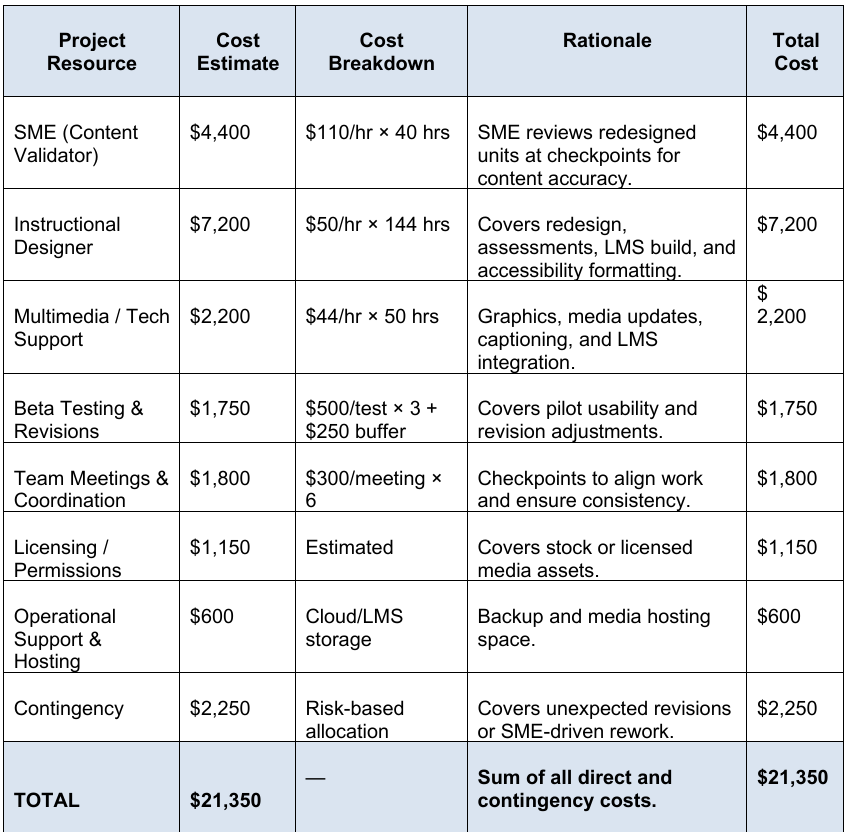
A cost analysis was performed in the first phase during the charter development. This demonstrates the ability to visualize the project and to break down the cost of the project as well as the rationale for doing so.
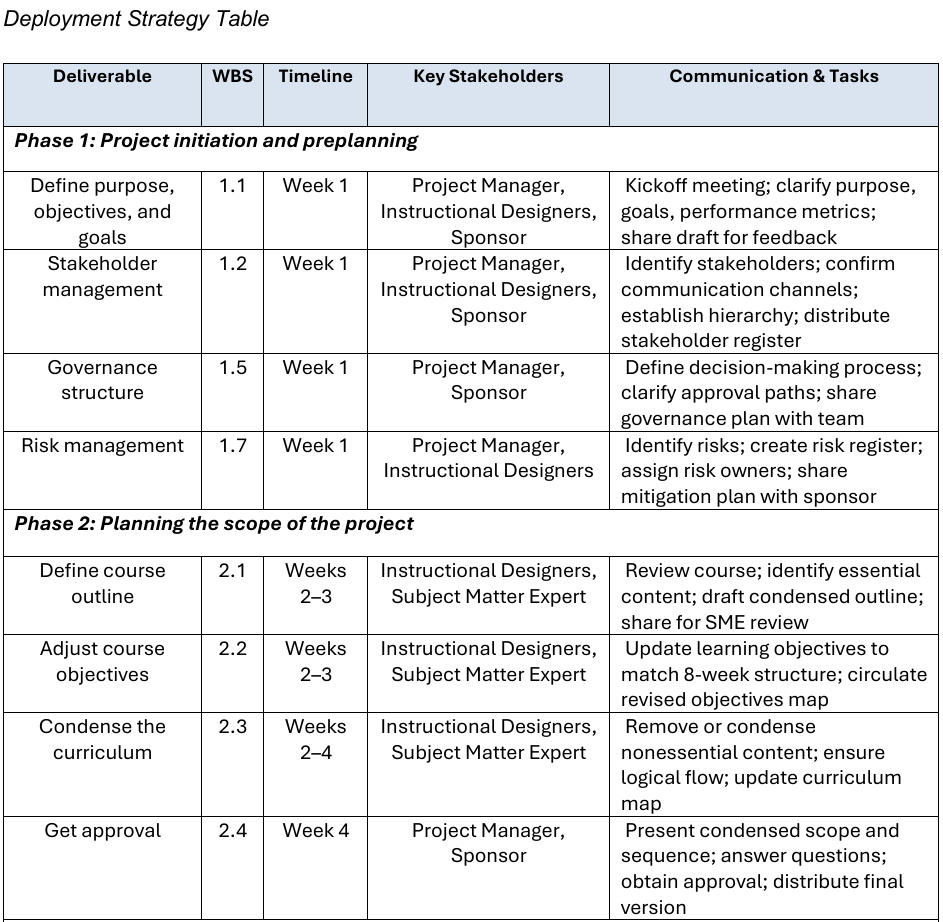
During phase 4 of the project, Implementation and Project monitoring, a final plan is made about the deployment of the project which includes the deliverable, the timeline, the key stakeholders involved as well as the tasks associated with every phase. This table was a culmination of the work done in previous stages of this project.
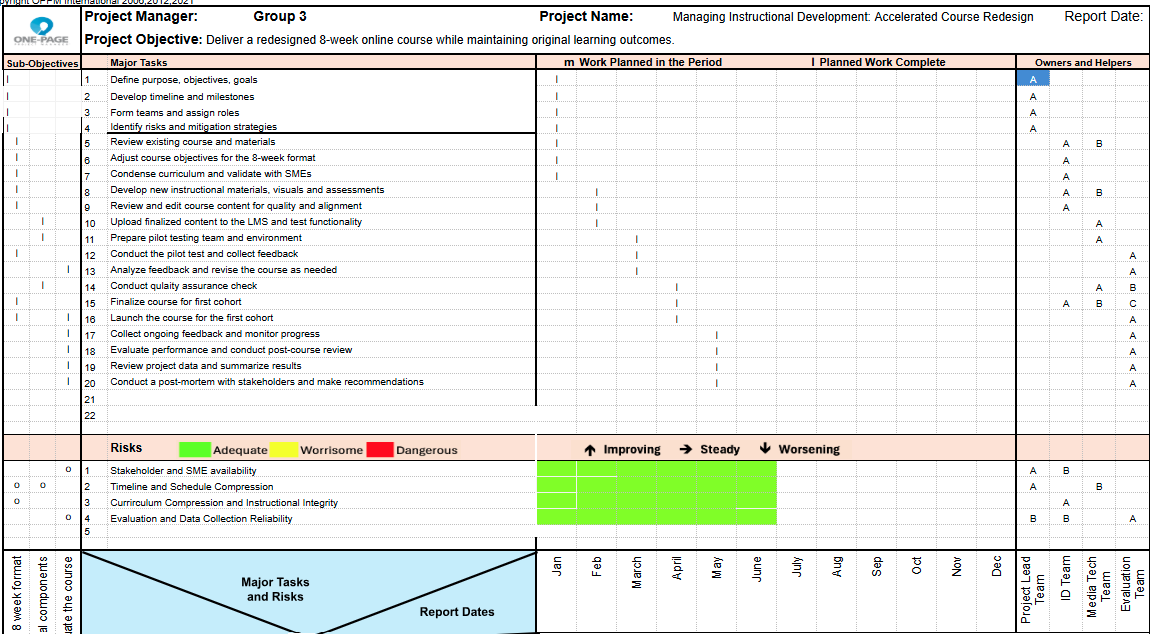
This is part of the one page project organizer that was mandatory to use throughout the project. This visual representation of the project lists the major tasks, the sub-objectives, those responsible for the various stages and deliverable of the project, a time line of when the tasks should be completed, as well as risk mitigation. This was maintained by the group throughout the project.
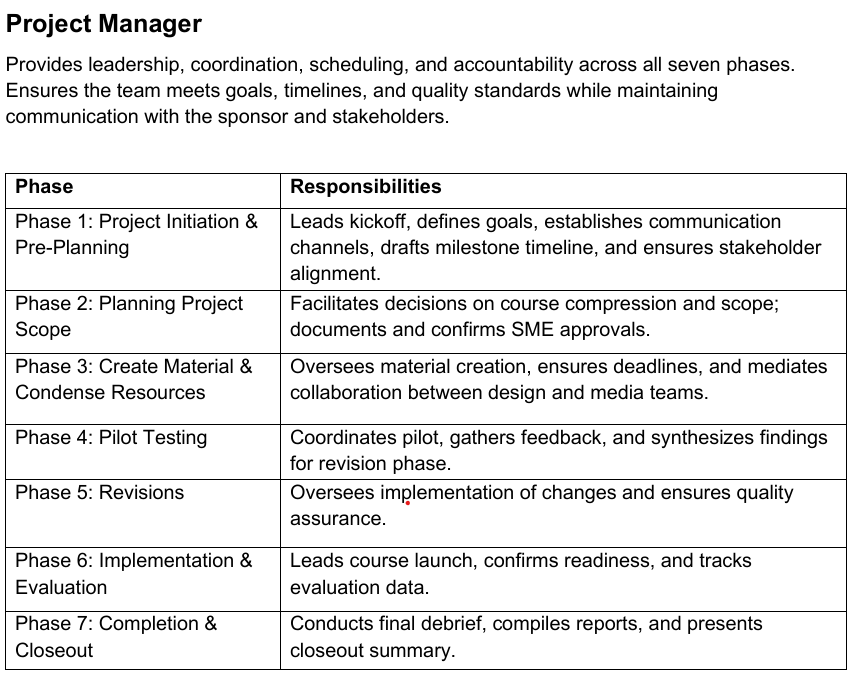
This table was created as part of phase 2 where the roles and responsibilities were defined at each stage of development. The project team structure delineates clear roles, responsibilities, and decision-making authority across all phases of the project. It provides a framework for accountability and communication across the life-cycle of the project, to ensure alignment with project goals, and provides transparent communication between the team and the sponsor. A table similar to this was made for every participant in the project so roles at every phase of the project were clear.